Course Syllabus
Course-PM
TDA342/DIT260 Advanced Functional Programming (7,5hp)
Department of Computer Science and Engineering
Chalmers University of Technology / Göteborg University
Course aim
The aim of the course is to explore the powerful mechanisms that functional programming languages offer to solve real problems and structure larger programs. The focus lies on library design and the concept of embedded languages.
Schedule
Lectures are given in hybrid format, in person in EDIT EF, and over Zoom.
Contact details
Teaching staff
- Andreas Abel (Lecturer, Examiner)
- Evan Cavallo
Evan: "I will have office hours on Tuesdays from 15-16 and Wednesdays 10-11, starting on 27 January. This is a drop-in session in room 6461. Please come prepared; be prepared to tell me clearly what your problem is and what you have tried yourself to solve it.
I will dedicate up to two hours more on Fridays towards office hours, but these need to be scheduled with ME beforehand. Priority will be given to students that have difficulty showing up during the drop-in session. Please send me an email to schedule such an appointment.
Please note that I am terrible at Windows, and if you have technical difficulties on your Windows-machine it is very unlikely that I will be able to help you. You can come and hope for the best, but prepare to be disappointed :)!"
Student representatives
| Program | First name | Last name | |
|---|---|---|---|
| MPALG | alva.m.andreasson@gmail.com | Alva | Andreasson |
| MPALG | philipp.i.holst@gmail.com | Philipp-Immanuel | Holst |
| MPALG | johnejansson@gmail.com | John | Jansson |
| MPALG | williamkarlsson0210@gmail.com | William | Karlsson |
| MPALG | depsterr@protonmail.com | Rachel | Samuelsson |
| GU | gusalbiot@student.gu.se | Albin |
Otterhäll |
Course material
The lecture content, the assignments and further material are available at https://teach-afp.github.io/www.
The code for the whole course is in https://github.com/teach-afp/afp-code -- and you can clone it!
Course literature
Real World Haskell by Bryan O'Sullivan, Don Stewart, and John Goerzen
There is an online version of it. Some related papers to read and other material will be provided with the lectures.
Extra reading material
These books are all good but presented in order of decreasing relevance for the AFP course.
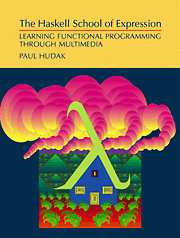 The Haskell School of Expression by Paul Hudak
 The Fun of Programming edited by Jeremy Gibbons and Oege de Moor
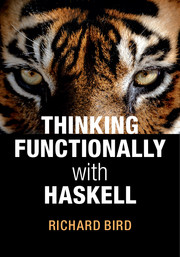 Thinking Functionally with Haskell by Richard Bird
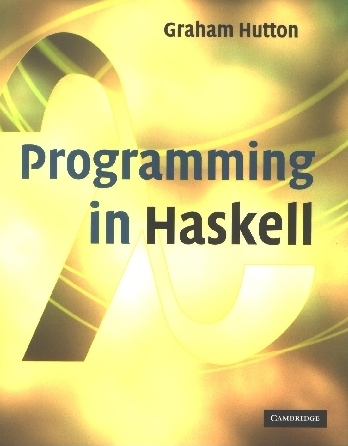 Programming in Haskell by Graham Hutton
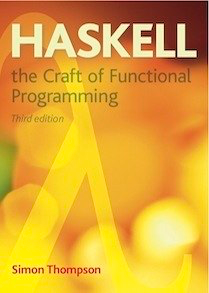 Haskell — The Craft of Functional Programming
Course design
Lectures
There are two 1.5-hour lectures every week. Students are expected to do a lot of independent programming and self-study. Lots of help is provided.
Assignments
There are three programming assignments, which you should do in pairs. If you have a good reason for doing the assignments by yourself or in a group of three, please contact the lecturer.
- You need to pass all three assignments and the exam in order to pass the course.
- Each of the assignments (except the last one) is divided into two parts with separate deadlines.
Deadlines
Examination form
To obtain the final grade, you need to pass all the assignments and the exam. Labs and exam are graded as 3, 4, and 5. The lab grade is the average of the individual grades for the 3 labs. The labs contribute 60% to the final grade and the exam contributes 40% to the final grade. The Chalmers grades are translated into the GU scheme in the usual way.
Learning objectives and syllabus
Learning outcomes
- Design embedded domain specific languages (EDSLs)
- Explain and exemplify (abstract) syntax, semantics
- Implement EDSLs in Haskell (as combinator libraries)
- Read, understand and extend Haskell programs which use advanced type system features
- Type classes
- (Generalized) algebraic datatypes
- Functors, monads and monad transformers
- Use specification based development techniques
- Formulate and test properties about the program
- Reason about correctness of functional programs
- Transform programs on the basis of such reasoning
- Explain and discuss the above topics
Detailed course syllabus
Changes made since the last occasion
- TBA
Course Summary:
| Date | Details | Due |
|---|---|---|